6 Sep 2026
Wine Journal vs Tasting Vault: Which Works?
Wine journal vs tasting vault: compare paper notes with a searchable tasting memory, and choose the method that helps you taste with more confidence now.
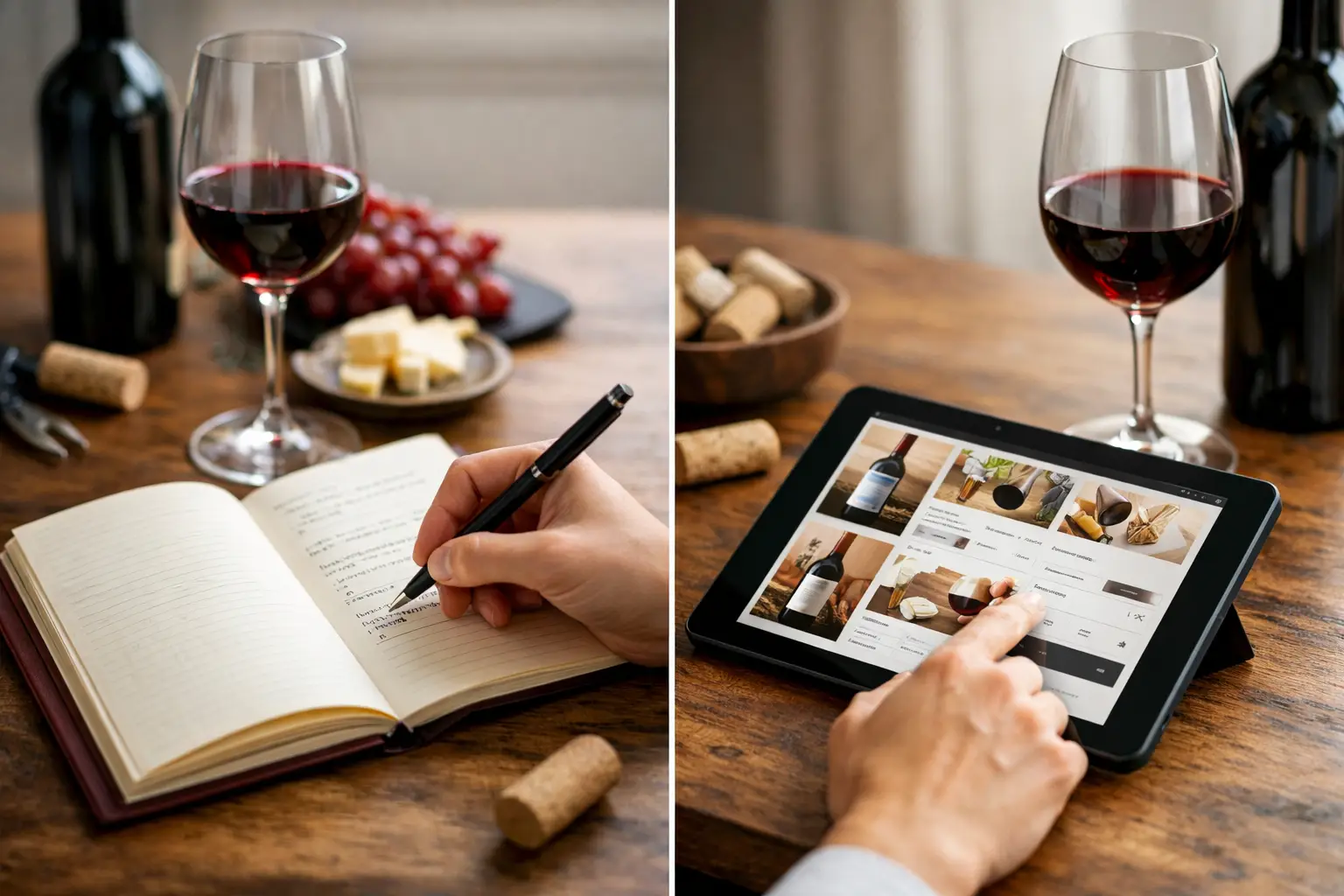
A bottle can be memorable on Friday night and strangely hard to describe by Sunday. You may remember that you enjoyed it, but not whether it was the bright acidity, soft tannins, smoky finish or simply the food and company. That is the real question behind wine journal vs tasting vault: are you looking for a pleasant record of the occasion, or a reliable way to build your tasting memory?
Both can make drinking more intentional. Neither requires expert knowledge, perfect descriptors or a shelf full of expensive bottles. The better choice depends on how you naturally take notes, how often you revisit past bottles, and whether you want your observations to become useful when choosing your next glass.
What a wine journal does well
A wine journal is simple by design. It might be a handsome notebook, a printed tasting diary or a notes app used only for wine. You open it beside the bottle, write what comes to mind, and create a physical record of an evening.
For many people, that ritual is the point. Handwriting slows you down. It asks you to pause after the first sip and notice a little more: the colour, perhaps, then citrus, black cherry, vanilla, pepper or a drying sensation on the gums. A blank page can feel less like a test and more like a private conversation with your own palate.
Paper also has very little friction. No sign-in, battery or screen is needed at the table. If you are travelling, sharing a bottle at a friend’s home, or simply want to keep your phone out of sight, a journal is a calm companion.
Its limitation appears later. Finding the Rioja you liked last autumn can mean turning pages and hoping you wrote the producer clearly. Comparing every Sauvignon Blanc you have tried over a year is possible, but it asks for patience and a consistent note-taking system. A journal records memories beautifully, yet it does not automatically connect them.
What a tasting vault adds
A tasting vault is a digital library of the bottles, beers, whiskies and other drinks you have tasted. Rather than storing notes only in the order you wrote them, it helps you save each item as something you can search, revisit and compare.
This matters when your interest starts growing. Perhaps you notice that you consistently enjoy wines with higher acidity, or that smoky whiskies work for you only after dinner. A vault can make those patterns easier to see because your notes are gathered in one place instead of scattered across pages.
With Audio Sommelier, the Smart Vault is designed around that practical next step: save an item and your impressions, then use those saved tasting memories to build comparative Flights over time. The aim is not to turn every drink into homework. It is to make the small observations you already have available when they can help.
A digital record can also be more forgiving for beginners. If you do not know the right word, you can start with plain language: “fresh”, “warming”, “a bit sharp”, “like baked apple”, or “would buy again”. Guided tasting support can then help you put better structure around that reaction. Your first notes do not need to sound like a critic’s review to become valuable.
Wine journal vs tasting vault: the differences that matter
The choice is less about analogue versus digital and more about what you want from your notes after the bottle is finished.
Capturing the moment
A journal often wins for atmosphere. There is pleasure in writing a date, sketching a label, or noting who was at the table. It becomes a keepsake as much as a tasting tool. If your main goal is to mark special meals, weekends away or memorable gifts, paper has genuine charm.
A tasting vault is usually faster when you want a repeatable habit. You can save the drink, record a few impressions and return to the evening without creating a long entry. This is helpful for ordinary midweek bottles, when the best system is the one you will actually use.
Finding what you learnt
This is where a vault has the clearer advantage. Searchable records help answer useful questions: Which white wines did I rate highly? What did I say about that Islay whisky? Did I prefer the lighter or richer version of a beer style? Your past tastes become something you can consult before shopping, ordering at a restaurant or opening a bottle from the rack.
A journal can offer the same insight only if you review and organise it regularly. Some enthusiasts enjoy that process. Others discover that their notes become a stack of good intentions.
Building tasting language
A notebook gives you complete freedom, which can be liberating or intimidating. Faced with an empty page, many people write only “nice” or “not for me”. There is nothing wrong with either response, but it does not tell your future self much about why.
A well-designed vault can prompt you to notice a few useful dimensions, such as aroma, texture, flavour and finish. This is not about forcing a verdict. It is about turning “nice” into something more helpful: “ripe peach aroma, creamy texture, dry finish, better with food than alone”. That level of clarity makes a real difference when you are learning your preferences.
Comparing rather than collecting
People often collect tasting notes without using them. A vault earns its place when it helps you compare drinks side by side or across time. You might place two Malbecs in a Flight, for example, and notice that one feels plush and chocolatey while the other is fresher, firmer and more herbal.
That comparison is difficult to hold in your head after a few weeks. It is also where confidence grows. You stop asking which bottle is objectively best and begin recognising what suits your own palate, occasion and meal.
Privacy and permanence
A paper journal is private if you keep it private, and it will still be readable when an app changes. That permanence is a fair reason to prefer it. It is worth considering how any digital service handles account security, billing and personal information before making it part of your routine.
Digital records, on the other hand, are less likely to be left in a drawer, damaged by a spill or forgotten on holiday. The right answer depends on whether you value physical ownership most or the convenience of having your tasting history available whenever you need it.
Choose the method that fits your drinking life
Choose a wine journal if tasting is a reflective ritual for you, particularly if you mostly want to preserve occasions and enjoy handwriting. It is also an excellent low-pressure starting point for someone who tastes only occasionally.
Choose a tasting vault if you want your notes to guide future choices. It makes more sense for regular home drinkers, curious hosts and developing hobbyists who want to remember bottles without building a spreadsheet. It is particularly useful if your interests extend beyond wine into beer, sparkling wine, whisky, spirits or liqueurs.
A hybrid approach can be surprisingly effective. Keep a journal for special bottles, travel and long-form reflections, then save the essential details digitally: what it was, what you noticed, how much you enjoyed it and whether you would choose it again. The journal keeps the story; the vault keeps the pattern.
Make every tasting note more useful
Whichever format you choose, consistency matters more than detail. You do not need to identify every aroma in the glass. Four small observations will give you a much stronger record than a paragraph written under pressure:
- The setting: what you were eating, the time of day or the occasion.
- The first impression: fresh, rich, light, savoury, sweet, smoky or warming.
- One specific sensory detail: lemon peel, red berries, toast, cocoa, pepper, creaminess or a dry finish.
- Your verdict: drink again, better with food, share with friends, or not quite for you.
Over time, those simple notes reveal more than an elaborate score. They show whether you prefer crisp whites to buttery ones, whether oak appeals to you, and which styles make an ordinary supper feel a little more considered.
The useful record is not the one with the most impressive vocabulary. It is the one you will return to before opening the next bottle, then use to notice one new thing in the glass.